

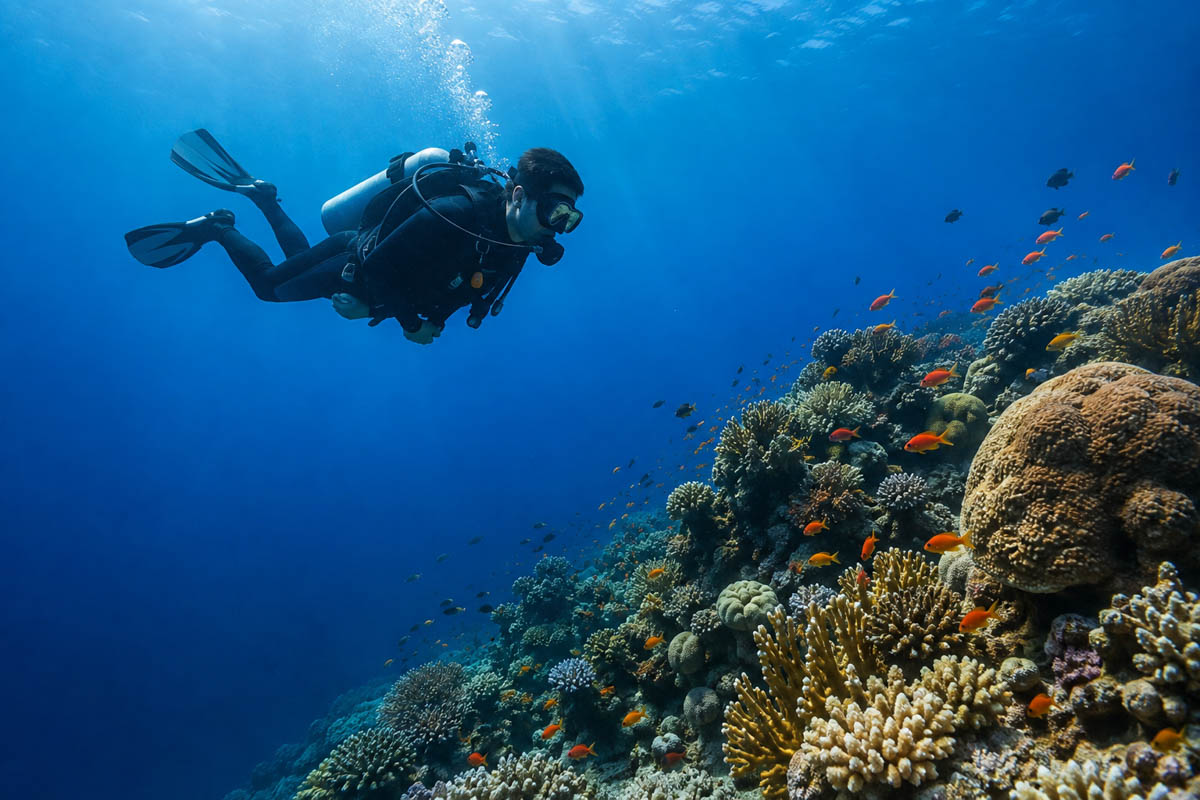

When I began recreational scuba diving in December 2025, I was immediately struck by the sheer diversity and beauty of the underwater world. Even now, returning to the same dive sites can give me that same sense of wonder.
Soon after earning my Open Water certification, I wrote about that experience for PADI and promised myself that I would write again when I became an Advanced Open Water Diver.
Four months and 26 logged dives later, I am now Advanced Open Water and Nitrox certified.

Yet one piece of advice I regularly give new divers might seem strange given my own progression: don’t be in too much of a hurry to collect your next certification.
When I say this, people sometimes ask an obvious question. If everything you learned during Open Water was still fresh in your mind, why not go straight into Advanced? If becoming an Advanced diver was always the intention, why wait?
There is also a perfectly reasonable financial argument for progressing quickly.
Scuba diving is not inexpensive, particularly for those of us who live far from dive centres. In my case, reaching my nearest dive centre involves a four-hour connecting flight followed by another 40km journey by bus or taxi. Add accommodation, transport, food and diving, and a three-day trip can easily cost upwards of ₹40,000.
From that perspective, completing multiple courses during the same trip can make financial sense.
But if your circumstances allow you to slow down, both literally and metaphorically, I believe there is something much more valuable to be gained.
Becoming a Better Diver Takes Diving
Entry-level training introduces new divers to essential skills including buoyancy, breathing, awareness and maintaining composure underwater.
Understanding those skills in theory, however, is very different from making them instinctive.
Most new divers will struggle with some combination of buoyancy, breathing, trim or spatial awareness during their early dives. That isn’t necessarily because their training has failed or because they lack ability. Diving is a practice-driven skill.
You become better at diving by diving.
A 2019 study examining 499 recreational divers in Italy and Mozambique looked at how accumulated diving experience affected divers’ perceptions of themselves, the environment and the destinations in which they dived.
The results were more complicated than simply saying experienced divers were “better.” Experienced divers tended to assess their own abilities more positively, but they were also less satisfied with aspects of dive-site health and management and tended to judge some environmental impacts of diving less critically than novice divers.
That nuance is important.
Experience changes the way we perceive the underwater world, but accumulating dives alone does not automatically make somebody more environmentally aware.
Instead of immediately asking, “Which certification should I do next?”, perhaps new divers should sometimes ask a different question:
“Would I benefit more from simply going diving?”
Spend time underwater. Become comfortable with your equipment. Learn what good buoyancy actually feels like rather than merely understanding how it works. Notice how your breathing affects your position in the water. Develop an intuitive understanding of how your body moves underwater.
Those things aren’t represented by another certification card, but they can fundamentally change the kind of diver you become.
The diving industry’s own progression systems recognise the importance of experience.
PADI, for example, requires 40 logged dives before starting its Divemaster programme and 60 before certification. Its Master Scuba Diver rating requires at least 50 logged dives alongside Advanced Open Water, Rescue Diver and five specialty certifications.
Progressing to instructor level also involves substantial experience, with 100 logged dives required before receiving the instructor credential.
There is a reason for that.
Experience matters.
Slow Down and You Start Seeing More
There is another reason I believe slowing down matters, and it extends beyond becoming a more capable diver.
It can also change our relationship with the environment we’re entering.
Scuba diving is generally regarded as a non-consumptive form of marine tourism. We enter the underwater world primarily to observe and experience it rather than remove things from it.
That doesn’t mean our presence has no impact.
Researchers have repeatedly documented physical contact between recreational divers and reef environments, including contacts that cause visible damage.
One study following 100 recreational divers at coral reef sites in the Philippines found that 88% made contact with the reef at least once during a dive. Of the contacts recorded, some resulted in observable damage to coral or other reef life.
Research in St Lucia has also found that factors such as camera use can significantly increase diver contact with reefs, while active intervention by dive leaders can substantially reduce contact rates.
Our behaviour underwater matters.
Research has also looked at the role played by the diving industry itself.
In 2017, researchers Serena Lucrezi and Melville Saayman examined the attitudes of dive operators towards sustainable resource use around marine protected areas in Mozambique and Italy.
They found that operators generally held positive attitudes towards sustainability, but often faced practical barriers to promoting it more actively within their businesses.
Protecting dive sites, therefore, isn’t simply the responsibility of one group. It requires action from operators, authorities, scientists and the divers themselves.
And that brings us back to slowing down.
Meaningful conservation becomes much harder if recreational divers never stop to consider the “why” behind their diving because they’re permanently focused on the “where”, “when” and “what next?”
Slowing down gives us an opportunity to pay attention.
Not just to our gauges, our depth and our buddy, but to what is actually happening around us.
From Underwater Visitor to Ocean Steward
The diving industry has increasingly tried to encourage that deeper relationship with the ocean.
PADI AWARE has spent decades involving divers in marine conservation, while its programmes include citizen science initiatives and conservation-focused education.
NAUI’s Green Diver Initiative was also established to promote aquatic conservation through education and environmental stewardship.
SSI, meanwhile, offers a Marine Ecology specialty designed to help divers better understand interactions between marine organisms and their environments.
These programmes encourage divers to become more than passive underwater spectators.
They encourage us to understand what we’re seeing.
There is, admittedly, a certain irony in recommending more certifications in an article arguing against the relentless pursuit of certifications.
But that’s not really my argument.
I’m not suggesting that divers should stop learning or progressing.
I am Advanced Open Water and Nitrox certified myself, and I wouldn’t trade those experiences for anything. I fully intend to continue learning.
What I question is the idea that progress as a diver must always be validated by the next certification.
There is another form of progression.
It happens when your buoyancy becomes instinctive. When you stop fighting your equipment. When your breathing becomes calmer. When you begin noticing things underwater that you previously swam straight past.
And perhaps, eventually, when the ocean stops being somewhere you simply visit and becomes somewhere you feel responsible for protecting.
So take the courses that genuinely interest you. Develop new skills. Continue your education.
But don’t become so focused on reaching the next rung of the certification ladder that you forget why you started diving in the first place.
Sometimes the most valuable thing you can do to become a better diver is remarkably simple.
Go diving.
Take your time.
And pay attention.
As the proverb goes: slow down, and you’ll get there faster.
Comments