



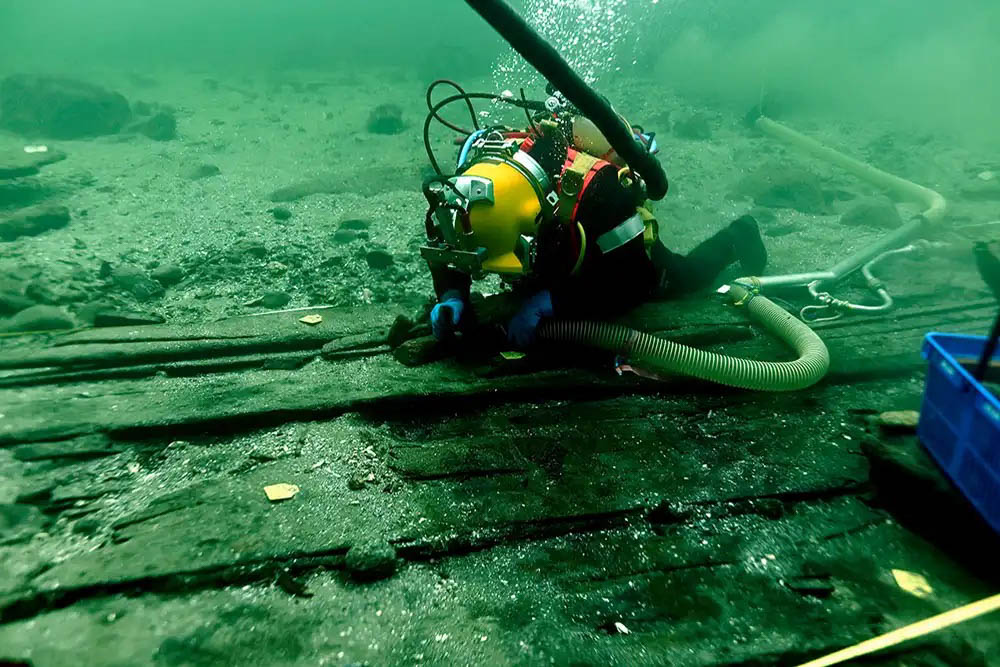

Marine archaeologists have confirmed the discovery of what is now believed to be the largest medieval cargo ship ever found, resting beneath the Øresund Strait near Copenhagen. The wreck, known as Svælget 2, is being described as a once-in-a-generation find that reshapes understanding of large-scale maritime trade in northern Europe during the early 15th century.
Researchers from the Viking Ship Museum in Roskilde, which is leading the excavation and analysis, have confirmed that the vessel measures approximately 28 metres in length and around nine metres wide, making it significantly larger than any medieval cog previously documented. The museum explains that the ship was uncovered during seabed investigations associated with infrastructure works in the Øresund, where thick sediment layers preserved much of the hull for more than 600 years.

Independent verification published by Smithsonian Magazine confirms that dendrochronological analysis of the oak timbers dates the vessel to around 1410. This places the ship firmly in the late medieval period, more than a century after the end of the Viking Age, despite some early reports incorrectly referring to it as a Viking shipwreck.
Further corroboration from The Independent highlights the unprecedented scale of the vessel, noting that its size suggests a cargo capacity of several hundred tonnes. Such capacity would have enabled the transport of bulk commodities including timber, stone, grain, and iron between major commercial hubs across the Baltic and North Sea, reflecting the rapid growth of European maritime trade during the early 1400s.
Additional technical details reported by The Maritime Executive reveal that timber used in the ship’s construction originated from regions corresponding to modern-day Poland and the Netherlands. This evidence points to sophisticated supply chains and specialised shipbuilding centres operating across northern Europe, challenging earlier assumptions about the limits of medieval naval engineering.

Archaeologists note that the exceptional preservation of Svælget 2 offers a rare opportunity to study medieval shipbuilding methods in situ, rather than relying on fragmented remains or artistic depictions. As analysis continues, the wreck is expected to become a benchmark for future research into medieval seafaring and the evolution of large merchant vessels.
Comments

