




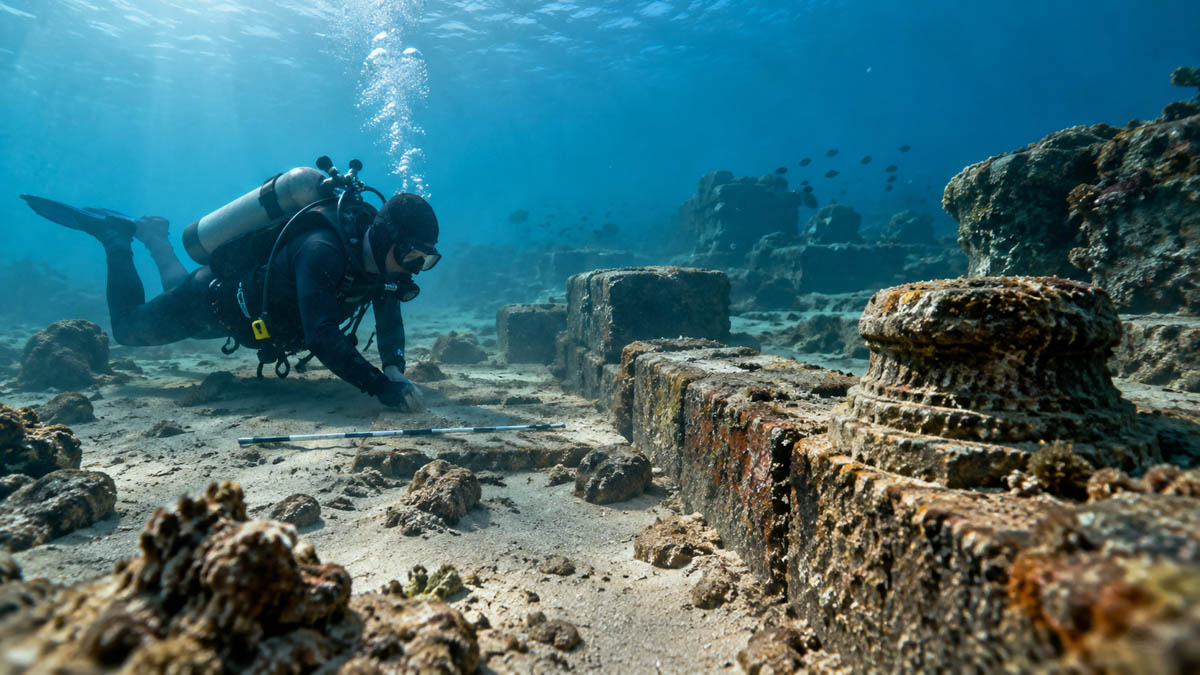

Underwater archaeologists have begun a new expedition off the coast of Tamil Nadu, India, in an effort to uncover more of Poompuhar, an ancient port city whose maritime history stretches back more than two thousand years.

The latest phase of exploration began on September 6, with the Tamil Nadu State Department of Archaeology working alongside the Indian Maritime University. According to The New Indian Express, the operation is scheduled to continue until September 23 and will investigate submerged structures, possible shipwrecks and evidence of the port’s historic trading connections.

The expedition is not simply a search for a legendary lost city. Poompuhar, also known as Kaveripoompattinam, is a documented ancient port at the mouth of the Cauvery River. Archaeologists have been investigating its coastal and underwater remains for decades, but important questions remain about the extent of the settlement, the age of individual structures and how changes to the coastline affected the city.

From seabed surveys to diving
The current operation combines marine survey technology with underwater investigation. Side-scan sonar and echosounders will be used to identify anomalies on the seabed, after which divers can examine locations that may warrant closer archaeological investigation.
The work follows preliminary studies in February 2025, underwater surveys later that year and diving operations in March 2026. Earlier investigations identified pottery fragments, submerged structural features and a possible shipwreck, although the interpretation of these findings requires further research.
The latest expedition aims to establish more about the ancient port’s layout, investigate possible wreck sites and study changes in sea levels and river courses. These questions could help researchers understand both Poompuhar’s maritime importance and the processes that left parts of its historic landscape beneath the sea.
Tamil Nadu’s Archaeology Minister, A Rajmohan, joined the launch and entered the water with archaeology officials and professional divers. DT Next reported that the minister had completed two days of scuba training in Chennai before observing work at a depth of approximately 10 metres.
His participation attracted considerable local attention, but the more significant story is the continuing scientific investigation of one of India’s most important ancient maritime sites.
A port connected to the wider world
Poompuhar occupies a prominent place in Tamil history and literature. The Tamil Nadu Department of Archaeology identifies it as a flourishing port city of the Sangam period and a second capital of the Cholas.
Excavations on land have revealed evidence of historic settlement and maritime activity, while underwater investigations have added another dimension to the city’s story. The department’s underwater archaeology records describe earlier discoveries of stone masonry and a shipwreck containing lead ingots, including examples stamped with dates from the late eighteenth century.
Those finds illustrate why the waters around Poompuhar are of interest to archaeologists. The area contains evidence from different periods, and individual discoveries must be dated and interpreted carefully rather than assumed to belong to the same ancient settlement.
The current expedition could help clarify how the port developed, how its shoreline changed and what physical evidence remains of the maritime networks that connected southern India with other parts of the world.
What happens next?
The immediate objective is to identify and investigate promising locations, not to announce that the full extent of an ancient city has already been discovered. Survey anomalies can have a range of explanations, and archaeological conclusions depend on examination, documentation and, where appropriate, excavation.
The expedition is expected to run until September 23. Any substantive findings announced by the archaeology department after the work concludes could provide a clearer picture of what has been discovered and what remains to be investigated.
For divers, Poompuhar is a reminder that some of the most compelling underwater exploration takes place beyond conventional recreational dive sites. Beneath the Bay of Bengal, marine archaeologists are using diving skills and modern survey technology to investigate a coastline whose history is still being pieced together.
Comments